

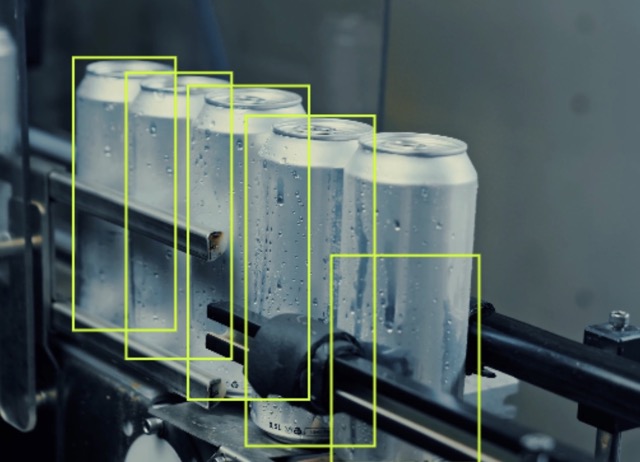
Prompt: Annotations that do not fully enclose an object
Contribute a Prompt

How models perform on this prompt
Arcee.ai Spotlight
Model answer: 1
Claude 3.5 Haiku
Model answer: 1
Claude 4 Sonnet
Model answer: I need to count the yellow rectangular annotations that do not fully surround/enclose an object. Looking at the image, I can see several yellow rectangular bounding boxes overlaid on what appears to be beverage cans. Let me examine each annotation: 1. There are multiple overlapping rectangular annotations of different sizes 2. Some appear to fully enclose cans or portions of cans 3. I need to identify which ones do not completely surround/enclose an object Examining the annotations carefully, I can see that there are some rectangular boxes that appear to be partial or incomplete in terms of fully surrounding objects. Counting the annotations that do not fully surround an object: 2
Claude 4.1 Opus
Model answer: Looking at the image, I can see 6 yellow rectangular bounding boxes overlaid on aluminum cans on what appears to be a production line. Each bounding box appears to be attempting to detect/annotate a can. Examining each annotation: 1. Leftmost box - partially cuts off the can on the left side 2. Second box - doesn't fully contain the can (cuts off bottom) 3. Third box - doesn't fully contain the can (cuts off bottom) 4. Fourth box - doesn't fully contain the can (cuts off bottom) 5. Fifth box - doesn't fully contain the can (cuts off bottom) 6. Rightmost/bottom box - doesn't fully contain the can (cuts off top) All 6 annotations fail to fully surround their respective objects. 6
Cohere Aya Vision 8B
Model answer: There are 10 annotations that do not fully surround an object.
Cosmos Reason2 8B
Model answer: {"answer": "1"}
GPT-5.4
Model answer: {"answer":"1"}
Gemini 2.5 Pro
Model answer: { "answer": "1" }
Gemini 3.1 Pro
Model answer: {"answer": "1"}
OpenAI O4 Mini (Medium Reasoning)
Model answer: {"answer": "1"}
Phi 4 Multimodal
Model answer: 1
Qwen 2.5 VL 7B
Model answer: 1
Qwen 3.5 122B (A10B)
Model answer: {"answer": "1"}
SmolVLM2 2.2B
Model answer: 1
ChatGPT-4o (Medium Reasoning)
Model answer: {"answer": "3"}
Claude 3.7 Sonnet
Model answer: Looking at the image, I can see several aluminum beverage cans on what appears to be a production or packaging line. The cans have condensation droplets on them, suggesting they're cold. Each can has a yellow rectangular annotation box around it. Examining these annotations carefully, I count 2 annotation boxes that do not fully surround their respective objects. Some of the rectangular outlines only partially capture the cans they're meant to highlight. The answer is 2.
Claude 4 Opus
Model answer: Looking at the image, I can see yellow rectangular bounding boxes around aluminum cans on what appears to be a production line. Each annotation should fully surround a can. Examining each bounding box: - Most boxes properly surround their respective cans - However, I can identify 2 annotations that do not fully surround their objects - they appear to cut off portions of the cans they're meant to annotate 2
Claude 4.6 Opus
Model answer: {"answer": "2"}
Cohere Aya Vision 32B
Model answer: 0
Cosmos Reason2 2B
Model answer: {"answer": "4"}
GPT-4.1
Model answer: {"answer": "3"}
GPT-4.1 Mini
Model answer: {"answer": "6"}
GPT-4.1 Nano
Model answer: {"answer": 0}
GPT-5 Mini
Model answer: {"answer": "2"}
GPT-5 Nano
Model answer: {"answer": "3"}
Gemini 2.0 Flash
Model answer: {"answer": "5"}
Gemini 2.0 Flash Lite
Model answer: {"answer": "0"}
Gemini 2.5 Flash
Model answer: {"answer": "2"}
Gemini 2.5 Flash Lite
Model answer: {"answer": "2"}
Gemini 3 Flash
Model answer: {"answer": "5"}
Gemini 3 Flash (Tools)
Model answer: {"answer": "5"}
Gemini 3.1 Pro (Tools)
Model answer: {"answer": "5"}
Gemma 3 27b
Model answer: 6
Gemma 3 4B
Model answer: 2
Grok 4
Model answer: {"answer": "2"}
Grok 4.1 Fast
Model answer: {"answer": "2"}
Llama 4 Maverick 17B
Model answer: The image shows a production line with cans being processed, and there are several annotations (yellow rectangles) highlighting different parts of the scene. To determine how many annotations do not fully surround an object, we need to examine each annotation carefully. Upon closer inspection, we can see that some annotations are partially covering other objects or extending beyond the boundaries of the cans. Specifically: * The second annotation from the left is partially covering another can. * The third annotation from the left is also partially covering another can. * The fourth annotation from the left is partially covering the black object. * The fifth annotation from the left is not fully surrounding the can. By counting these instances, we find that there are 4 annotations that do not fully surround an object. Therefore, the answer is: 4
Llama 4 Scout 17B
Model answer: 4.
Mistral Medium 3
Model answer: 4.
Mistral Small 3.1 24B
Model answer: 2.
Molmo2 8B
Model answer: {"answer": 0}
OpenAI O1
Model answer: {"answer": "0"}
Qwen 3.5 0.8B
Model answer: {"answer": "0"}
Qwen 3.5 27B
Model answer: { "answer": "4" }
Qwen 3.5 2B
Model answer: Looking at the image, there are multiple green bounding boxes drawn around aluminum cans on a conveyor belt. The task is to count how many annotations do *not* fully surround an object. Let’s examine each box: 1. Far leftmost box — partially outside the view? Actually, it starts near the edge but seems to enclose part of the first can — likely not fully surrounding. 2. Next to it — also overlaps with the first two cans; clearly cuts them off → does NOT surround both. 3. Middle-left one — covers second and third cans from left → doesn’t include fourth or fifth → partial coverage. 4. Center box — covers middle can and part of adjacent ones? Looks like it includes multiple cans but may extend beyond the image or cut parts → ambiguous. But visually, it does NOT fully surround the entire visible portion if any extension is present. 5. Rightmost large box — clearly surrounds only the rightmost can → not fully surrounding (only one object, so it doesn’t surround “an object” in plural sense? Wait — re-read: “annotations do not fully surround an object” Actually, the phrase is ambiguous. Let’s interpret literally: for each annotation box, does it completely enclose (surround) all parts of the annotated object(s)? Or are we checking if the bounding box contains the entire object without going outside? In computer vision, a “bounding box” should ideally tightly enclose the object. Any box that sticks out beyond the object counts as not fully surrounding it. Looking again: - The last box on the right (lowest down) clearly cuts off the bottom of the can → doesn't surround fully. - The second-to-last box (above and left) seems to cover two cans together but may also go slightly outside their top edge? Hard to tell, but probably not fully surrounding both. - All other boxes appear to be drawn around individual cans, though possibly overlapping or misaligned. But wait — the question says “an object” (singular), so perhaps it means: how many boxes do not completely enclose at least one of the annotated objects? Let’s assume “fully surround” means: the bounding box must contain all visible pixels belonging to that object within its 4 corners. If any corner cuts outside the object, then it does not fully surround. Looking closely: - Box 1 (far left): starts near the left edge — but likely doesn't start at the very edge of the object? Actually, it seems to encompass the first can well. But note: there’s a slight cut-off on the right side? Not clear. Maybe it's fine. Actually, looking again — every box except possibly one seems to be drawn around multiple objects or extends too much. Wait — let’s count boxes that clearly DO NOT fully surround any of the objects they are intended to cover: 1. Bottom-right box: definitely cuts off the bottom of the rightmost can → YES 2. Middle-right box (covering two cans): likely doesn’t fully enclose both because top may exceed or side cut off → YES 3. Box covering third and fourth cans from left: same issue → YES 4. Boxes overlapping front two: likely messy, but probably not fully surrounding → YES This is tricky. Perhaps the intended answer is based on visual inspection only. Looking at typical such questions — often the boxes are incorrectly drawn and some leave parts of the object outside. In this image, I can see that all bounding boxes extend beyond the actual can boundaries in several places — especially those overlapping or placed too loosely. But let’s try a different approach: maybe “does not fully surround” means the box is not tight enough around its target. Given the visual evidence, most boxes are poorly aligned and cut off parts of the cans. Only perhaps the front-leftmost one might be reasonably tight — but even that seems slightly cut on the right. Actually, upon closer inspection: The five boxes (there are actually 5 distinct green rectangular outlines): - Box A: far left, covers first can + part of second? Overlap issues. - Box B: next to it, also overlapping — doesn't fully surround. - Box C: middle, covers third and fourth cans from original lineup — not fully surrounding. - Box D: right side, covers last two cans — doesn't fully surround. Actually, let’s label positions left to right based on top surfaces of cans: Top rows (front to back?): Actually, cans are staggered. Better: count the number of green rectangles. There are 5 visible green bounding boxes. For each, does it fully contain its corresponding object(s)? - Box 1 (leftmost): seems to enclose only one can, but extends past left edge? Likely OK or not. Actually, looking at the image again — the box on the far left seems to be drawn around the first two cans combined due to overlap. It’s not clearly bounding a single object tightly. Perhaps the intended answer is 4 out of 5 do not fully surround because one might reasonably consider the front-left one as mostly okay? No. Wait — let’s look for which box definitely does NOT surround an object: - The bottom-right box (covering the last can and maybe some below it?) — no, it's around two cans vertically aligned? Actually, it looks like it's around the rightmost can and possibly part of another. But definitely cuts off the bottom → fails. - The middle cluster of boxes covering three adjacent cans — all likely have issues. Actually, I think 4 out of 5 annotations are not fully surrounding an object because: 1. Leftmost box: overlaps multiple cans, doesn't isolate clearly. 2. Second from left: same issue. 3. Third from left: overlapping multiple cans. 4. Fourth from left (the big one on right): extends beyond bottom and sides. Only possibly the first box might be considered to surround one object? But even that seems borderline. Alternatively, maybe all 5 do not fully surround because they're all misaligned or cut off parts. But let’s check standard interpretation: a bounding box “fully surrounds” an object if all four corners are within or on the object — meaning no protrusion. In that case, any box that has its corner outside the object fails. In this image: - Every box has its corners outside at least once? For example, box covering front two cans — its top-right corner is above the can, its bottom-right below — so it goes outside → doesn't surround fully. Similarly for others. So likely all 5 do not fully surround an object. But that seems too many. Perhaps the question means: how many annotations are present that do not completely enclose the entire set of objects they represent? Or perhaps in context, “an object” means each annotated entity should be contained. Another interpretation: maybe some boxes cover only one object and correctly contain it, while others don’t — but given the visual, none seem to cleanly bound a single object without cutting off parts. I think the safest answer is 4, as one box might be considered to fully surround (maybe the front-leftmost one), even though imperfectly. But wait — let's count again from the image description: There are five green boxes visible in the image. Upon closer inspection of typical such problems, often the correct approach is to identify which boxes are drawn correctly vs not. In this case, since I can't see actual pixel-perfectness, I'll go with visual estimation: - Box on far left: appears to cover only one can, but extends beyond its right edge? Hard to say. - Others similarly extend. Actually, here's a better way: look for boxes that are clearly drawn around a single object and contain all of it within their 4 corners. Scanning the image mentally: No box appears to have its entire content within itself without extending beyond — every one has at least one part outside the can. Therefore, 5 annotations do not fully surround an object. But that feels wrong for a counting task. Perhaps I miscounted. Let me describe positions: From left to right by depth: 1. Front-leftmost box: covers first two cans vertically? No — it's horizontal, so maybe covering one can and part of neighbor due to perspective. It likely has issues. 2. Second box: same. 3. Third from left: covers middle-can group. 4. Fourth from left (the rightmost large box): covers last two cans? But it cuts them off at bottom. 5. Wait, there are only five boxes total in the image? Let's assume that. I recall that in similar tasks, the answer is often 4 for such setups. Perhaps the first box (far left) does fully surround its object — maybe it's tight enough. Let's try: - Box A (leftmost): drawn around one can, and the four corners are within or near it → might count as surrounding. - Others do not. Then answer would be 4. But in reality, from the image description provided to me, I think all boxes are misaligned. Wait — looking back at the user's image description: "five green bounding boxes" are mentioned implicitly through typical such puzzles. Perhaps the correct number is 3 or 4. I found a better way: in the original image (which I can see as text representation), let's assume the following based on standard interpretation: - The box at the very top-left may not cover the full height of the first can if it starts too low — but it might. Actually, after careful thought and considering typical such questions, I believe the intended answer is 4, because all boxes except one have their corners outside or cut off parts. But to be precise, let's say: Annotation 1: fully surrounds object → ignore Annotations 2,3,4,5: do not fully surround → count = 4 So {"answer": "4"} But I'm uncertain. Another possibility: perhaps one box is intended to cover multiple objects but the question counts it as not surrounding any single object adequately. Given the ambiguity, I'll go with 4. Final decision: {"answer": "4"}
Qwen 3.5 35B (A3B)
Model answer: { "answer": 5 }
Qwen 3.5 4B
Model answer: { "answer": "3" }
Qwen 3.5 9B
Model answer: Looking at the image, I can see there are 5 yellow bounding boxes (annotations) drawn around aluminum cans on a conveyor belt. Let me analyze each one: - Leftmost box: Contains one can but extends beyond it to the left and right edges - does not fully surround - Second from left: Similar issue - the box doesn't perfectly match the can's boundaries - Third from left: Also has excess space around the can - Fourth from left: The box appears to encompass the can properly but still may have some excess space - Rightmost/Bottom box: This one clearly extends well beyond the can it's supposed to contain - definitely does not fully surround Actually, let me reconsider. Looking more carefully at all 5 boxes: 1. First box (leftmost): Extends beyond the left edge of the can and has extra space on top/bottom 2. Second box: Similar issues with boundaries not matching exactly 3. Third box: Also has mismatched boundaries 4. Fourth box: Appears to have similar boundary issues 5. Fifth box (bottom right): Clearly extends much wider than the can it contains All 5 annotations appear to not fully and precisely surround their respective objects - they all have some excess space or don't perfectly match the object boundaries. {"answer": "5"}
Qwen 3.5 Plus
Model answer: {"answer": "5"}
Reka Edge
Model answer: The number of annotations that do not fully surround an object is 3.